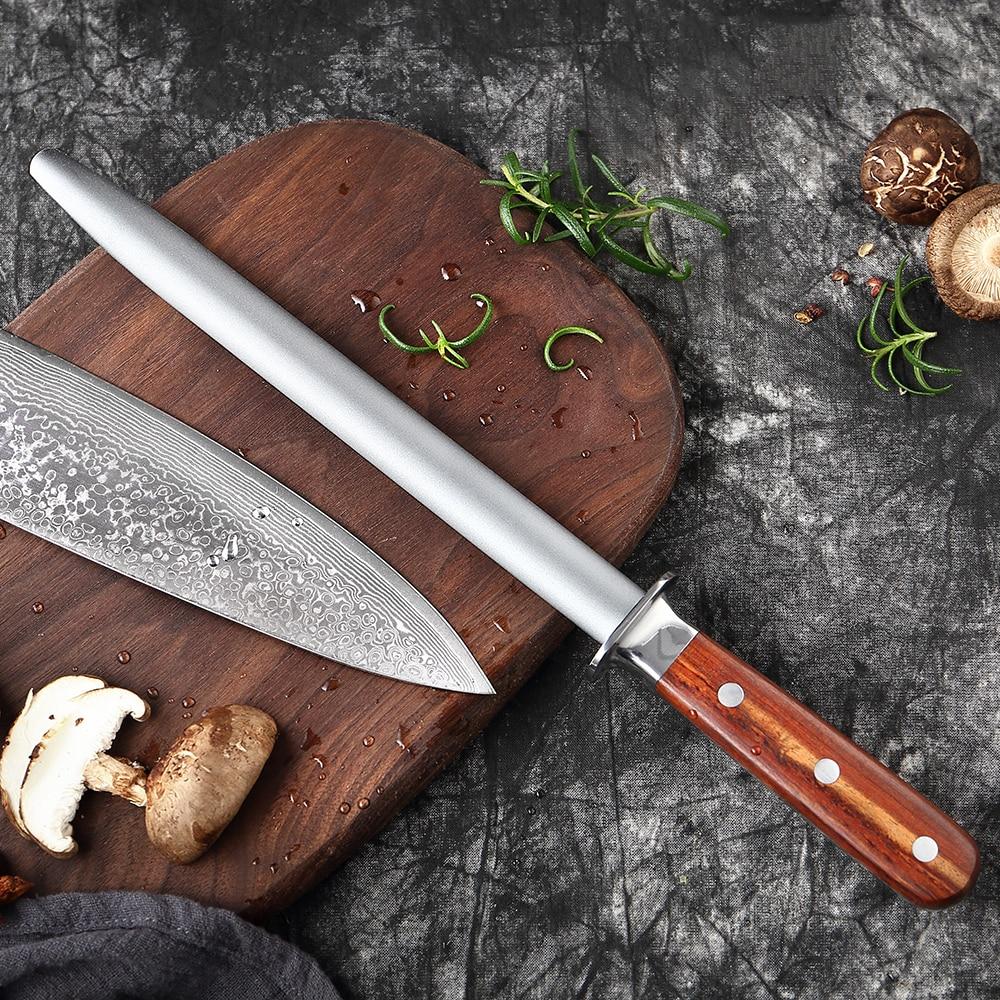
Japanese kitchen knives are the most technically refined cutting tools available to a home cook. Not as a matter of brand loyalty but as a matter of metallurgy, geometry, and a craft tradition that has been refining the same principles...
The blade gets all the attention. Steel grade, HRC rating, edge angle, Damascus layers — these are the specifications buyers research before buying Japanese kitchen knives. The handle is often treated as an afterthought, a matter of aesthetics rather than...
Walk into any knife shop and you'll see "hand-forged" treated as the highest compliment a knife can receive. Browse any knife brand's website and "forged construction" appears in the first paragraph as a signal of quality. The implication is always...
Pick up any serious Japanese knife and you'll eventually see a specification that reads "single bevel" or "double bevel" — sometimes written in Japanese as 片刃 (kataba) or 両刃 (ryōba). It sounds technical. It is technical. But it's also one...
Japanese knives span one of the widest price ranges of any kitchen tool — from under $50 to well over $1,000 for a single blade. If you're new to the category, that range is confusing. If you've been cooking with...
There's a moment every cook experiences the first time they use a truly great Japanese chef knife — the way it glides through an onion without effort, the way a tomato yields to the blade instead of collapsing under it....
When you look at a Japanese knife listing and see "made in Sakai" or "Seki, Japan," that information carries more meaning than a simple geographic label. Japan's knife-making regions are not interchangeable production centers. They are distinct craft ecosystems, each...
Every Japanese knife carries a history that most owners never know. The thin geometry, the hard steel, the single-bevel grind on a Yanagiba, the laminated construction of a Damascus Gyuto (as well as other Japanese kitchen knives) — none of...
The honest answer to this question is: longer than almost any other kitchen tool you own — and probably longer than you expect. A quality Japanese knife in VG10 or AUS10 stainless steel, maintained properly, will last 20–30 years of...
Most home cooks own a Western knife. They may not know it by that name — it's usually just "the chef's knife" sitting in the block, or the Wüsthof or Henckels that came as a gift years ago. It does...
Pick up a Japanese chef's knife and a German chef's knife of the same length. You'll notice the weight difference immediately. The German knife feels solid, substantial — a tool with presence. The Japanese knife feels almost light by comparison,...
Steel is the soul of a Japanese knife. Every other decision — handle style, blade shape, construction method, price — flows from what the steel can and cannot do. And yet steel specifications are where most buyers' eyes glaze over...
A Japanese knife is designed to last decades — the blade height alone gives it enough steel for a hundred sharpenings before the geometry is exhausted. But that longevity is conditional. The harder steel that makes Japanese knives sharper and...